Chord Finder
Find any chord fast. Choose a root note and chord type to see its notes and intervals, a playable guitar shape in standard tuning and the keys to press on piano. Or work backwards: type the notes you are playing and the finder names the chord, including inversions.
- Free to use
- No sign-up
- Runs in your browser
Chord finder
Chord Chart Reference Pack
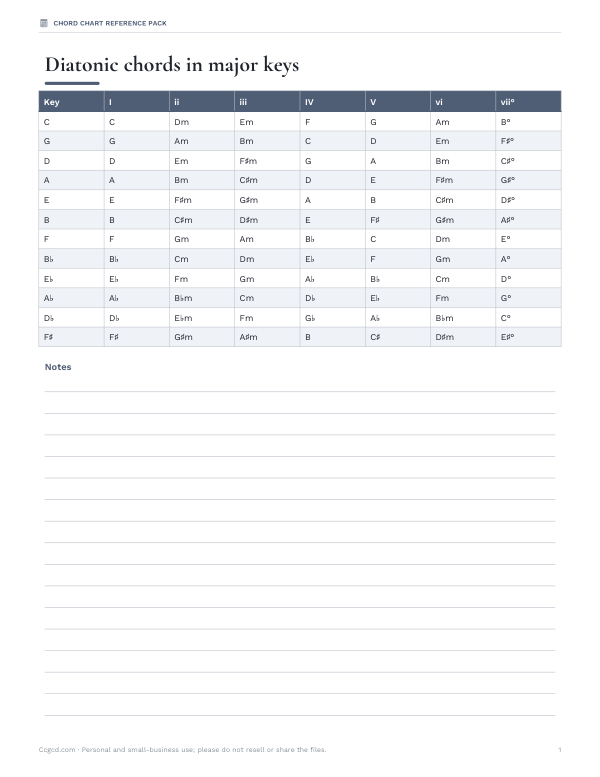
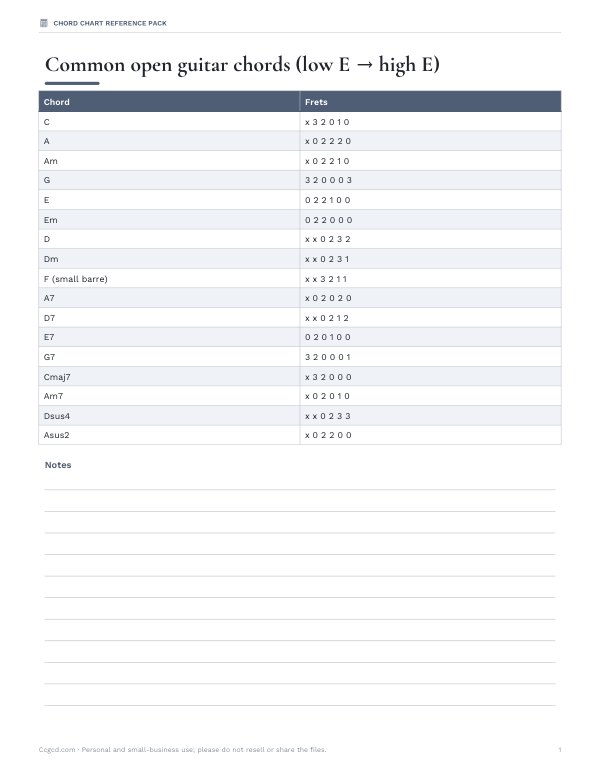
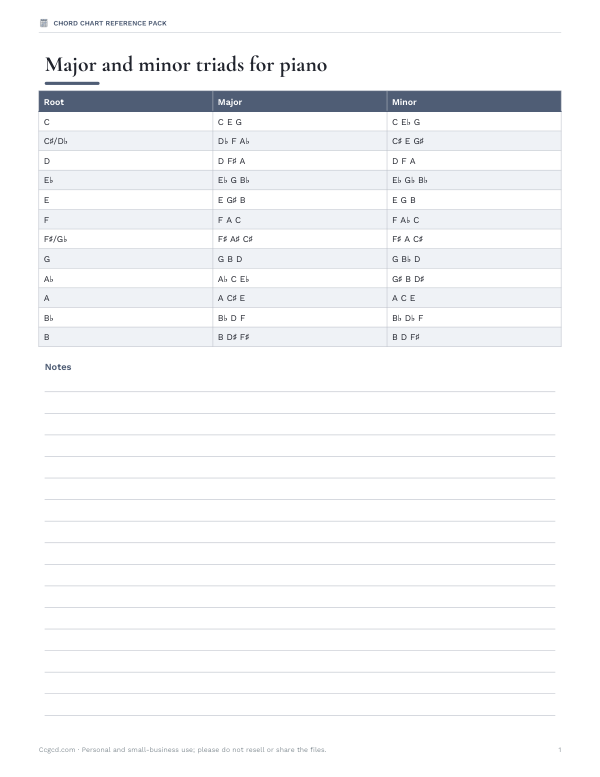
Printable guitar chord charts (open and barre shapes), a piano chord chart for all 12 keys, a chords-in-every-key table and blank chord diagram sheets.
- Chords in every key (PDF, XLSX)
- Open guitar chords (PDF)
- Piano chord chart (PDF)
- Blank chord diagrams (PDF)
Formats: PDF, XLSX. Instant download after payment (link valid 72 hours, up to 5 downloads). AI-assisted: the templates were drafted with AI help and reviewed and laid out before publishing.
$4.00 USD, one-time 4 files · about $1.00 each
- Instant download
- 7-day refund
- Secure checkout by Stripe
7-day money-back guarantee. Full refund within 7 days of purchase, even after you download.
Free sample: Blank Chord Diagrams (PDF, 57 KB)
Full refund within 7 days — see the refund policy and license.
Free printables
Single sheets you can print right now, no sign-up. The full pack adds every sheet in one download plus the editable files.
 Printable Blank Guitar Chord Diagrams
How chords are built
A chord is three or more notes played together, built by stacking intervals above a root note. A major chord takes the root, the major third (4 semitones up) and the perfect fifth (7 semitones up): A major is A–C♯–E. A minor chord lowers the third by a semitone: A minor is A–C–E. Seventh chords add a fourth note — a minor seventh (10 semitones) for dominant and minor 7ths, a major seventh (11 semitones) for maj7. Once you know the formulas, you can build any chord from any root.
Chord formulas
| Chord | Symbol | Intervals | Example (C) |
|---|---|---|---|
| Major | C | R 3 5 | C E G |
| Minor | Cm | R ♭3 5 | C E♭ G |
| Dominant 7th | C7 | R 3 5 ♭7 | C E G B♭ |
| Major 7th | Cmaj7 | R 3 5 7 | C E G B |
| Minor 7th | Cm7 | R ♭3 5 ♭7 | C E♭ G B♭ |
| Suspended 2nd | Csus2 | R 2 5 | C D G |
| Suspended 4th | Csus4 | R 4 5 | C F G |
| Diminished | Cdim | R ♭3 ♭5 | C E♭ G♭ |
| Diminished 7th | Cdim7 | R ♭3 ♭5 ♭♭7 | C E♭ G♭ A |
| Half-diminished | Cm7♭5 | R ♭3 ♭5 ♭7 | C E♭ G♭ B♭ |
| Augmented | Caug | R 3 ♯5 | C E G♯ |
| Major 6th | C6 | R 3 5 6 | C E G A |
| Dominant 9th | C9 | R 3 5 ♭7 9 | C E G B♭ D |
| Add 9 | Cadd9 | R 3 5 9 | C E G D |
| Power chord | C5 | R 5 | C G |
Reading the guitar diagram
- Vertical lines are strings, low E on the left to high E on the right.
- Horizontal lines are frets; a thick top line is the nut. A number such as “5fr” means the diagram starts at the 5th fret.
- Blue dots are fingered notes, labelled with their interval (R = root, 3 = third, and so on).
- ○ above a string means play it open; × means do not play it.
- The numbers under the diagram give the fret for each string from low to high, e.g. “x 0 2 2 1 0” for A minor.
- Press “Next guitar voicing” to see other shapes for the same chord up the neck.
Identifying a chord from notes
Type the notes you are playing, lowest first, such as E G C. The finder tests each note as a possible root against the chord formulas and names the first match. If the lowest note is not the root, it shows the chord as a slash chord — C/E means a C major chord with E in the bass, the first inversion. Spell notes with # or b (C# or Db); both names for the same pitch work.
Why the same chord has many shapes
On guitar, each note appears in several places on the neck, so every chord can be played in many positions. Open chords near the nut ring out with open strings and are easiest for beginners. Barre chords move one shape up and down the neck to play any root. Higher voicings with fewer strings suit rhythm parts in bands, where they leave room for bass and keys. The finder searches for shapes that span four frets or fewer, start from the root on the lowest played string and include all the essential notes.
Worked example
A songwriter wants a gentler sound than D major in a progression. They choose root D and type “add 9”: the notes are D–F♯–A–E. The finder’s first guitar shape is x 5 4 2 3 0, with the open high E string adding the 9th on top, and the piano diagram lights up D, F♯, A and E. Typing the notes back into “identify” as D F# A E returns Dadd9, confirming the spelling.
Chord theory tips
- In any major key, chords built on the scale degrees follow the pattern major, minor, minor, major, major, minor, diminished (I ii iii IV V vi vii°).
- The dominant 7th (V7) creates tension that resolves to the tonic (I).
- Sus chords sound open because they have no third; they often resolve to the major or minor chord.
- Power chords (root and fifth) are neither major nor minor, which is why they suit distorted guitar.
- Adding a 9th or 6th colours a chord without changing its basic function.
Common progressions to try
| Progression | In C | In G |
|---|---|---|
| I – V – vi – IV | C – G – Am – F | G – D – Em – C |
| I – IV – V | C – F – G | G – C – D |
| ii – V – I | Dm7 – G7 – Cmaj7 | Am7 – D7 – Gmaj7 |
| vi – IV – I – V | Am – F – C – G | Em – C – G – D |
Use the finder to look up each chord’s notes and shapes, then try the progression in different keys by changing the root.
Privacy
All chord calculations happen in your browser; nothing is uploaded or stored.
Frequently asked questions
How do I find the notes in a chord?
Pick the root and chord type; the finder lists the notes and intervals.
What notes are in an A minor chord?
A, C and E.
How do I identify a chord from notes?
Type the notes, lowest first, in the identify box; the finder names the chord and any inversion.
What does the “x” on a chord diagram mean?
Do not play that string.
What is the difference between add9 and 9?
Add9 adds the 9th to a triad; a 9th chord also includes the ♭7.
Does it work for piano?
Yes, the piano diagram highlights the chord’s notes.
Why does the finder show a different shape from my chord book?
Every chord has several shapes; press Next guitar voicing to see alternatives, including common open and barre shapes.